tariffsSection 122Section 232data-centershyperscalerscapex

July 24 Is Not Priced Into AI Infrastructure

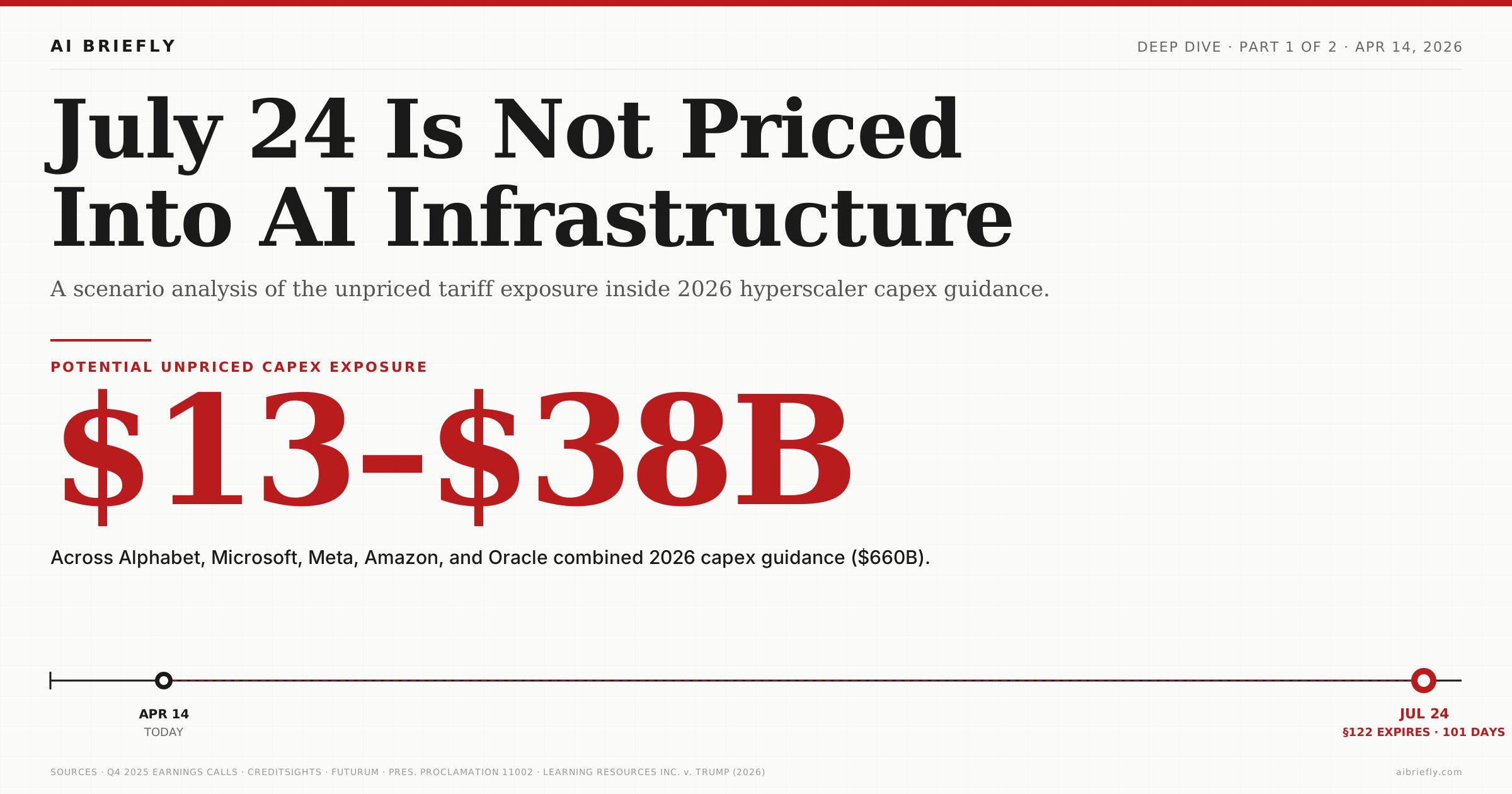
The 2026 hyperscaler capex bridge carries $13 to $38 billion of unpriced tariff cost that did not appear in any Q4 earnings call. Section 122 expires on July 24, but the duties do not come off - only the legal authority collecting them rotates. The 60 to 90 day handoff window is the tradeable event.

July 24 Is Not Priced Into AI Infrastructure: $13-$38 billion of unpriced capex exposure in 2026 hyperscaler bridges, repricing on the Section 122 expiration.

TLDR

$660 billion in 2026 hyperscale capex guidance and not one CFO mentioned transformers, switchgear, or steel tariffs. The construction bucket is carrying $13 to $38 billion of unpriced tariff cost.
When Section 122 expires on July 24, the duties don’t come off, but the legal authority collecting them changes.
That 60 to 90 day handoff window is not in any consensus estimate on power-heavy data center REITs and AI-exposed hyperscalers.

AI Briefly Deep Dive | Part 1 of 2 | April 14, 2026

  1. The short version
  2. The tariff stack on AI infrastructure since February
  3. A tariff's journey through a hyperscale bill of materials
  4. Why the AI capex model can't assume mean reversion
  5. July 24 as a repricing event for AI infrastructure
  6. How to position
  7. Sources

The short version

  • Alphabet, Microsoft, Meta, Amazon, and Oracle guided 2026 total capex to roughly $660 billion combined (Alphabet $175-185B and Amazon $200B disclosed; Meta $115-135B; Oracle $50B target; Microsoft $120B+ inferred). None of those Q4 2025 earnings calls included tariff exposure on transformers, switchgear, steel, or aluminum in the capex bridges. The word "tariff" did not appear on the Alphabet call.
  • The $660B is the total company capex figure, not data center carveouts. Futurum's 2026 analysis puts roughly 65 percent of hyperscaler capex on data center construction and other infrastructure (the remaining 35 percent on GPUs and servers), or approximately $429 billion across the five companies.
  • The unpriced tariff exposure on the data center construction portion works out to roughly $13 to $38 billion across the five companies. This is a scenario estimate, with the range factoring in sourcing mix, contract timing, and pass-through assumptions.
  • Chinese large power transformer stack under HTS 8504: Section 301 (25 percent) plus Section 122 (10 percent) = roughly 35 percent on the import value. Structural steel for the pad and aluminum for the bus bar imported separately under HTS Chapters 72 and 76 carry the March Section 232 rate of 50 percent. Switchgear, breakers, and HVAC equipment (HTS 8535, 8536, 8415) ride the same 301-plus-122 combination as the transformer.
  • Korean sourcing is cleaner on paper. Commerce's February 2026 preliminary results for the 2023-2024 antidumping administrative review put the margin at zero percent for HD Hyundai Electric and Iljin Electric, the two mandatory respondents. LS Electric retained 16.87 percent and Hyosung Heavy Industries was newly assigned 4.32 percent. The binding constraint on Korean sourcing in 2026 is capacity allocation, not duty.
  • Lead times are the second dimension. WoodMac's Q2 2025 survey put large power transformer lead times at 128 weeks and generator step-ups at 144 weeks. A hyperscale data center campus that priced a 2027 online date in 2024 has already slipped to 2028 on the transformer delivery alone. A new campus entering the pro forma process today should model a 2029 online date at the earliest, with grid interconnect queues adding another 12 to 24 months.

Related Deep Dives